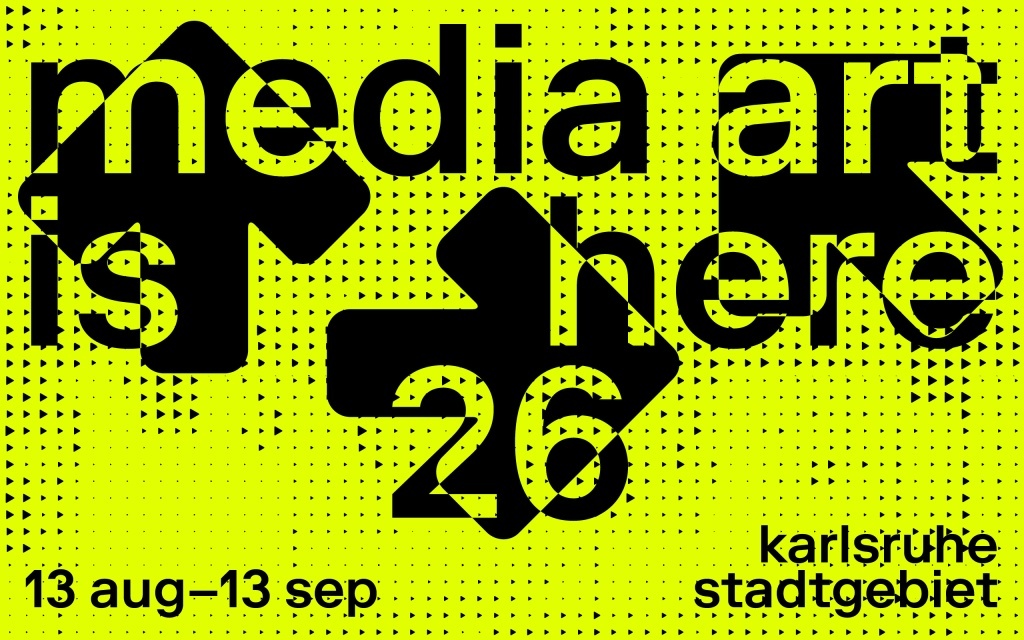
Media art is here [Opening]
[ ↓↓ English version below ↓↓]
Vom 13.08. bis 13.09. verwandelt sich die Stadt Karlsruhe in einen Ausstellungsraum unter freiem Himmel!
Die künstlerischen Positionen bespielen zentrale Orte – vom Marktplatz über den Alten Flugplatz bis an die Alb. Die Medienkunstwerke schaffen neue Verbindungen zwischen urbanem Raum, Natur und Gesellschaft. Sie machen Unsichtbares sichtbar: Mikroplastik im Flusswasser, Entwaldung als Rhythmus, Klimadaten als Klang. Die Präsentation findet parallel zum SCHLOSSLICHTSPIELE Light Festival statt und lädt vier Wochen lang dazu ein, Karlsruhe durch Medien- und Lichtkunst neu zu entdecken.
Die feierliche Eröffnung findet am 12. August um 18.30 Uhr im ZKM Karlsruhe statt. Alle Interessierten sind herzlich willkommen!
Die Künstler:innen nutzen wissenschaftliche Verfahren, historische Bezüge und partizipative Formate, um Orientierung zu finden in einer sich rasant wandelnden Welt, die eine freiheitliche Grundordnung in Frage stellt. Sie fragen: Wie können wir die ökologischen Herausforderungen unserer Zeit begreifen? Welche Geschichten erzählen militärische Spuren im Stadtraum? Und wie entstehen neue Formen von Gemeinschaft?
Sie laden ein zum Perspektivwechsel – auf Moos, auf Bürokratie, auf queere Sichtbarkeiten. Medienkunst wird hier zum Instrument gesellschaftlicher Reflexion: präzise, poetisch, politisch.
Mehrere Arbeiten machen Umweltveränderungen erfahrbar, die sonst unsichtbar bleiben. Die Künstler:innen arbeiten mit wissenschaftlichen Methoden: Rasterelektronenmikroskopie oder Geodatenanalyse. Diese künstlerischen Übersetzungen schaffen einen neuen Zugang zu abstrakten Zahlen. Sie verbinden lokale Orte mit globalen Prozessen – und erinnern daran, dass vermeintlich ferne ökologische Krisen uns unmittelbar betreffen.
So setzen Norina Quinte, Andreas Hölldorfer (ato) und VOLNA mit der Pyramide von morgen auf dem Marktplatz ein visuelles Statement zum Klimawandel und schlagen eine Brücke zwischen der Geschichte der Stadt und ihrer ökologischen Zukunft. Die Medienkunstinstallation wird eine temporäre, begehbare Pyramidenstruktur in derselben Größe und Form wie die historische Pyramide auf dem Marktplatz sein.
Vera Gärtner macht mit Live from Plastisphere die Mikroplastik-Verschmutzung in der Alb durch sehr großformatige Aufnahmen eines Rasterelektronenmikroskops sichtbar. Ihre poetisch-wissenschaftliche Annäherung an lokale Umweltprobleme erstreckt sich über das Schaufenster im Museum beim Markt und die Fischtreppe am Thomaswehr.
Antoine Bertin übersetzt für 555 Hz Entwaldungsstatistiken in Beats pro Minute. Im daraus resultierenden Takt schlagen mehrere Metronomone und senden ein Lichtsignal. Dadurch setzt er dem abstrakten Verlust ein physisch und zeitlich erfahrbares Denkmal im Schlossgarten.
Auch die Künstlerin Lucile Schwörer-Merz arbeitet mit Geodaten für ihre interaktive Klanginstallation meteo flux – eine Symphonie der Atmosphäre, die im Fasanengarten ausgestellt ist. Meteorologische Echtzeitdaten werden mit dem 40-Jahres-Mittelwert verglichen; Abweichungen werden hör- und sichtbar gemacht. Je nach Wetterlage und Bewegung der Besuchenden verändert sich ihre Arbeit.
Desiree Kabis und Eveline Vervliet laden mit ihrer Installation Through Moss-Colored Glasses zu einem Perspektivwechsel ein. Die im Titel angekündigte „moosfarbene Brille“ übersetzt menschliche Bewegungen in die Sprache dieser oft übersehenen Lebewesen und eröffnet dadurch eine queere, nicht-menschliche Sichtweise auf Zusammenleben und Gemeinschaft. Erlebbar ist die Installation am Pavillon des Naturkundemuseums und im Regierungspräsidium.
Das Duo IRIS-A-MAZ transformiert in der Kinemathek Peter Paul Rubens‘ Höllensturz der Verdammten in einen endlosen Schwebezustand. Ihre Videoarbeit Himmelssturz, speziell für die Phonolux-Maschine entwickelt, macht das Kino-Foyer zur Schwelle zwischen Realität und Filmwelt, zwischen Kontrolle und Befreiung.
Weitere Arbeiten spüren militärischen und gesellschaftspolitischen Prägungen im Stadtraum nach. Sie verbinden historische Orte mit aktuellen Fragen: nach Sichtbarkeit, nach Schutzräumen, nach möglichen Zukünften. Die künstlerischen Interventionen machen deutlich, dass Geschichte nicht abgeschlossen ist – sie wirkt fort in Infrastrukturen.
Welche Vergangenheit prägt unsere Gegenwart? Dieser Frage gehen in 2 Flächen bewegen, 50 km/h, Schritttempo Isabel Motz, Nis Petersen und Josefine Pilar Scheu nach. Sie verbinden mit ihren Performances und einem Audiowalk zwei gegensätzliche Karlsruher Orte: den ruhigen Alten Flugplatz und die verkehrsreiche Kriegsstraße. Durch performative Spaziergänge und Autofahrten werden die militärischen Prägungen beider Orte sichtbar gemacht und Fragen nach möglichen Zukünften der Stadt gestellt.
Für unser zwischenmenschliches Zusammenleben und die Machtinstrumente, die dies organisieren, sensibilisieren Yulia Mashkova und Grisha Mumrikov in Fragile Homes. Ihre Projektion für die Schlosslichtspiele sowie die Skulpturen im öffentlichen Stadtraum erinnern daran, dass es sich um Menschen handelt und dass das Papier, auf dem unsere Bürokratie fußt, eine natürliche und endliche Ressource ist.
Karolina Sobel thematisiert in der Videoarbeit Soft Signals im ZKM-Foyer queere und feministische Sichtbarkeit sowie die Fragilität von Schutzräumen. Das Gemeinschaftsprojekt entstand in Zusammenarbeit mit Natia Chikvaidze und Davit Khorbaladze aus Tiflis und nimmt die georgische Malerin Elene Akhvlediani (1898–1975) zum Ausgangspunkt.
In Fortsetzung des 2024 gestarteten Austausches zwischen den Medienkunststädten Cali und Karlsruhe entwickeln Lehel Lajos und Daniela Vargas ihre Arbeit No Longer Not Yet (2025) weiter. Bei Yvonne Hohner Contemporary zeigt Memoraque eine Installation, die einem Traum zu entstammen scheint und in ein spannungsvolles Spiel zwischen Fluss und Echo hineinzieht.
Einen Schritt weiter geht SangDoo Nam; er nutzt den öffentlichen Raum als Bühne für neue Formen des Austauschs. Seine Installation verwandelt den Kirchplatz St. Stephan in einen besonderen Pop-up-Store, an dem Menschen ihre Geschichten gegen Bilder tauschen können. Hier entsteht Kunst als soziale Praxis jenseits musealer Konservierung.
Im studio hö erarbeitet Stipendiatin Isabelle Konrad in ihrem transmedialen Projekt FURIE eine neue visuelle Sprache für weibliche Wut. Kein Zufall, dass das Wort Hysterie vom griechischen hysterá – „Gebärmutter“ – kommt und dass die Furien der Mythologie als Rachegöttinnen gefürchtet wurden, nicht als Gerechtigkeitsbringerinnen. FURIE fragt, was mit dieser aufgestauten Energie passiert und was entsteht, wenn sie sich endlich Raum nimmt. Das Gesamtprojekt ist als langfristiger Bild- und Klangatlas angelegt, der über das Stipendium hinauswächst.
Alle ausgestellten Arbeiten, bis auf Echo einer Ordnung, FURIE, Fragile Homes, Light up Weinbrenner, Memoraque und One way or another, sind 2024 und 2025 durch das Projektförderprogramm Medienkunst der UNESCO Creative City of Media Arts Karlsruhe gefördert worden.
/-/-/
From August 13 to September 13, the city of Karlsruhe transforms into an open-air exhibition space.
From the Marktplatz, through the Alte Flugplatz, to the Alb, visitors can experience contemporary media artworks free of charge and gain new perspectives on public space and our role within it. The presentation runs alongside the SCHLOSSLICHTSPIELE Light Festival and, for four weeks, invites visitors to rediscover Karlsruhe through media and light art.
The artistic works occupy central locations – from the Marktplatz to the Alter Flugplatz [old airfield] and along the river Alb. The media artworks create new connections between urban space, nature, and society. They make the invisible visible: microplastics in river water, deforestation as rhythm, climate data as sound. The exhibition runs parallel to the SCHLOSSLICHTSPIELE Light Festival and invites visitors, over the course of four weeks, to rediscover Karlsruhe through media and light art.
The official opening takes place on August 12 at 6:30 p.m. at the ZKM Karlsruhe. Everyone interested is warmly welcome.
The artists draw on scientific methods, historical references, and participatory formats to find orientation in a rapidly changing world that challenges liberal-democratic order. They ask: How can we grasp the ecological challenges of our time? What stories do military traces in urban space tell? And how do new forms of community emerge?
Visitors are invited to a shift in perspective – on moss, on bureaucracy, on queer visibility. Media art becomes an instrument of social reflection here: precise, poetic, political.
Several works make environmental changes tangible that would otherwise remain invisible. The artists use scientific methods such as scanning electron microscopy or geodata analysis. These artistic translations create new access to abstract figures, linking local places with global processes – and remind us that seemingly distant ecological crises affect us directly.
Norina Quinte, Andreas Hölldorfer (ato), and VOLNA make a visual statement on climate change with their Pyramide von morgen [Pyramid of Tomorrow] on the Marktplatz, bridging the city’s history with its ecological future. The media art installation is a temporary, walkable pyramid structure matching the size and shape of the historical pyramid on the square.
Vera Gärtner, with Live from Plastisphere, makes microplastic pollution in the Alb river visible through very large-format images taken with a scanning electron microscope. Her poetic-scientific approach to local environmental problems is on view at the shop window of the Museum beim Markt and at the fish ladder by the Thomaswehr.
Antoine Bertin, in 555 Hz, translates deforestation statistics into beats per minute. In the resulting rhythm, several metronomes strike and send out a light signal, creating a physically and temporally experienceable monument to this abstract loss in the Schlossgarten.
Artist Lucile Schwörer-Merz also works with geodata for her interactive sound installation meteo flux – eine Symphonie der Atmosphäre [a symphony of atmosphere], exhibited in the Fasanengarten. Real-time meteorological data is compared with the 40-year average; deviations are made audible and visible. Depending on the weather and the movement of visitors, her work changes.
Desiree Kabis and Eveline Vervliet invite a shift in perspective with their installation Through Moss-Colored Glasses. The “moss-colored glasses” announced in the title translate human movements into the language of this often-overlooked lifeform, opening up a queer, non-human view of coexistence and community. The installation can be experienced at the Naturkundemuseum pavilion and at the Regierungspräsidium.
The duo IRIS-A-MAZ transforms Peter Paul Rubens’ The Fall of the Damned into an endless state of suspension in the Kinemathek. Their video work Himmelssturz, developed specifically for the Phonolux machine, turns the cinema foyer into a threshold between reality and film world, between control and liberation.
Other works trace military and socio-political imprints in urban space. They connect historical sites with current questions: about visibility, about safe spaces, about possible futures. These artistic interventions make clear that history is not over – it continues to act through infrastructure.
Isabel Motz, Nis Petersen, and Josefine Pilar Scheu pursue the question of what past shapes our present in 2 Flächen bewegen, 50 km/h, Schritttempo. With their performances and an audio walk, they connect two contrasting Karlsruhe locations: the quiet Alter Flugplatz and the busy Kriegsstraße. Through performative walks and car rides, the military imprints of both places are made visible, and questions about the city’s possible futures are raised.
Yulia Mashkova and Grisha Mumrikov raise awareness, in Fragile Homes, of our interpersonal coexistence and the instruments of power that organize it. Their projection for the Schlosslichtspiele, along with the sculptures in public space, remind us that real people are involved, and that the paper on which our bureaucracy is built is a natural and finite resource.
Karolina Sobel addresses queer and feminist visibility as well as the fragility of safe spaces in her video work Soft Signals in the ZKM foyer. The collaborative project was created together with Natia Chikvaidze and Davit Khorbaladze from Tbilisi and takes the Georgian painter Elene Akhvlediani (1898–1975) as its starting point.
Continuing the exchange between the media art cities of Cali and Karlsruhe that began in 2024, Lehel Lajos and Daniela Vargas further develop their work No Longer Not Yet (2025). At Yvonne Hohner Contemporary, Memoraque shows an installation that seems to stem from a dream, bringing it into a tense interplay of river and echo.
SangDoo Nam goes a step further, using public space as a stage for new forms of exchange. His installation turns the Kirchplatz St. Stephan into a special pop-up store where people can trade their stories for images. Here, art becomes a social practice beyond museum preservation.
At studio hö, scholarship holder Isabelle Konrad develops a new visual language for female rage in her transmedia project FURIE. It’s no coincidence that the word “hysteria” comes from the Greek hysterá – womb – and that the Furies of mythology were feared as goddesses of vengeance, not as bringers of justice. FURIE asks what happens to this pent-up energy, and what emerges once it finally claims space. The overall project is conceived as a long-term image and sound atlas that grows beyond the scholarship itself.
All exhibited works, except Echo einer Ordnung, FURIE, Fragile Homes, Light up Weinbrenner, Memoraque und One way or another, were funded in 2024 and 2025 by the Medienkunst project funding program of UNESCO Creative City of Media Arts Karlsruhe.