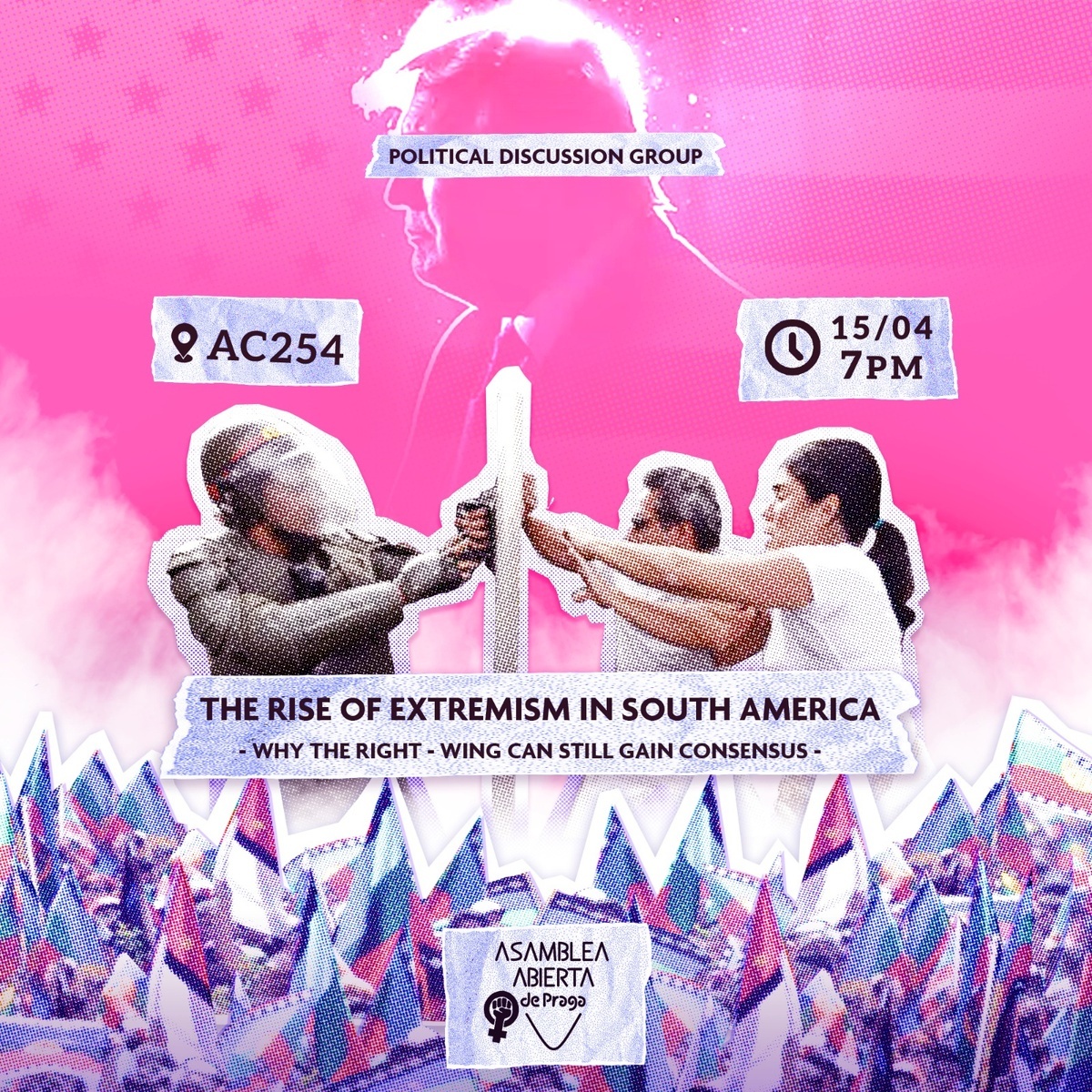
The rise of the far right in Latin America - (Discussion Group)
Asamblea Abierta de Praga invites:
Open political discussion group in Prague – come and participate!
Theme: The rise of the far right in Latin America; Why does it keep gaining consensus and captivating public opinion? Why do popular sectors, which have historically identified with the left, now see these leaders as an option?
In Czechia, the far right (SPD and Motoristé) already influences the government – "Trumpism" has already arrived in the heart of Europe. But perhaps there is a key difference: While in Czechia politics is framed as "democracy vs authoritarianism," in Latin America the phenomenon is much cruder: people perceive that voting does very little – it doesn't solve hunger, insecurity, or precarity. Politics is experienced as a circus, and the far right capitalizes on that rage by promising to "blow up the system" – as a response to the disillusionment with liberal democracy.
Some of the hypotheses from the left to explain this phenomenon are as follows:
1. Crisis of representation and failure of "progressivism" – One of the most solid theses points out that the advance of the far right is, paradoxically, the child of the crisis of neoliberalism and the inability of the governments that followed it.
2. Asymmetric polarization": rebellion dresses up as the right – It's a common mistake to believe that rebellion and social rage can only translate into left-wing votes. Faced with popular exhaustion, figures like Milei, Kast, or Bolsonaro channel discontent not against capitalism, but against "political elites," "progressivism," or the poor (whom they blame for the crisis), constructing an authoritarian and liberal common sense.
3. The return of the Monroe Doctrine by the United States – Trumpism has launched an offensive to retake undisputed control of the region, challenge geopolitical powers like China, and stop any attempt at autonomous integration. The far-right governments are, in this sense, the executing arms of this new recolonization.
4. Neofascism and the culture of "order" – More than populism, what we see is neofascism. These projects share a common core: authoritarianism, reactionary nationalism, the cult of the leader, and the targeting of "scapegoats" (immigrants, feminists, dissidents).
5. The Bukele factor: exception or model? – The analysis here is more complex: he is not a classic neoliberal like Milei, but his government has mutated toward "bourgeois Bonapartism." His success lies in having broken with the old corrupt political caste and offering tangible results (security) that the Salvadoran left (FMLN) failed to provide, thus winning the loyalty of broad popular sectors.
Date: April 15th
Time: 7 PM
Location: AC254 / Argentinská 783/18, Prague.
About us:
Asamblea Abierta de Praga is a leftist collective established by migrants and locals in Prague. With our work, we seek to build broad and plural alliances with other similar groups and people in the city.